
Un Linux completo dentro de una pestaña: Unkernel y Trynix llevan el kernel a WebAssembly
Dos proyectos arrancan Debian 13 y NixOS dentro del navegador, con kernel real y sin hipervisor. Nacieron en dos semanas, con ayuda de modelos de lenguaje, y apuntan a un cambio de capa: la pestaña como sustituto de la máquina virtual.
Two projects boot Debian 13 and NixOS inside the browser, with a real kernel and no hypervisor. They appeared within two weeks, with help from language models, and point to a layer change: the tab replacing the virtual machine.
Una pestaña, 2 GB y dos núcleos
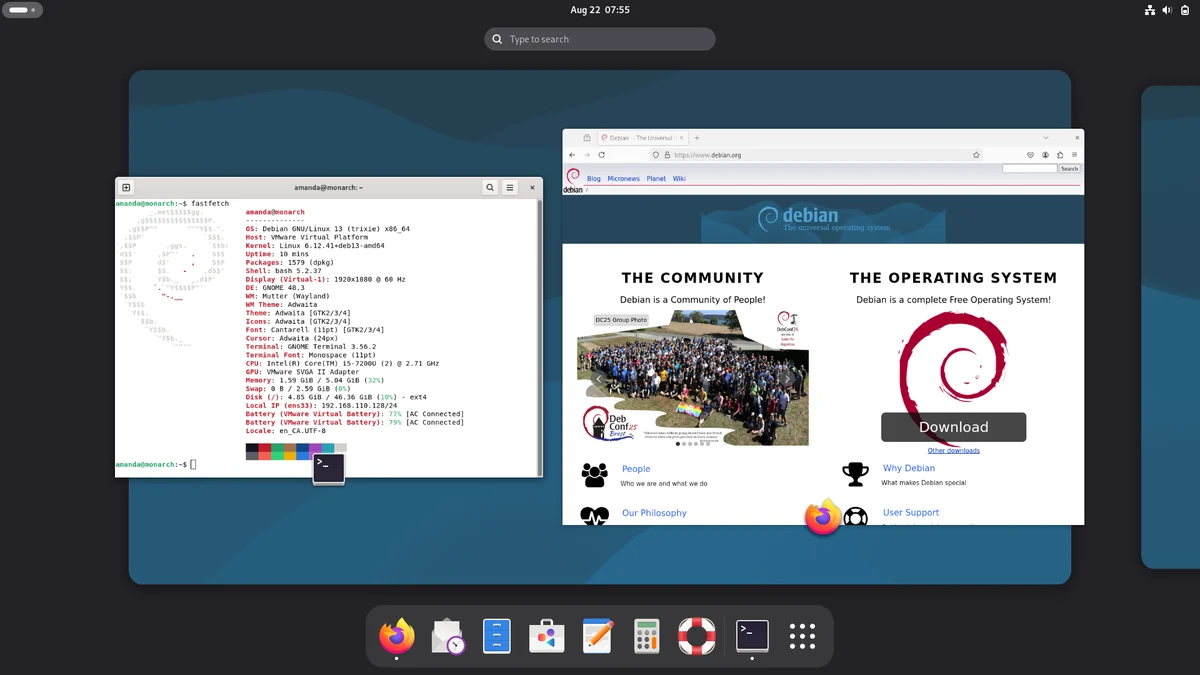
El 15 de noviembre, el desarrollador iraní Pooya Parsa anunció Unkernel; el 19 publicó la versión 0.2. La idea: arrancar un kernel de Linux real dentro de un entorno Arm64 escrito en Zig y compilado a WebAssembly. Al abrir unkernel.dev, el navegador levanta Debian 13 con 2 GB de memoria y dos núcleos virtuales, una interfaz Wayland mínima y un lanzador con Super+K. Sí, también corre Doom.
No hay hipervisor ni máquina virtual. El kernel y los binarios que ejecuta son los mismos que correrían en hierro, compilados a un formato que cualquier navegador ya sabe ejecutar.
Trynix y el multiverso de Nix
Días después, Farid Zakaria publicó «2035 came early» y su propio proyecto, Trynix, que cambia Debian por NixOS y abre el catálogo de Nix: cerca de un tercio de millón de programas y versiones. Trae Wayland, OpenGL y sonido ALSA, así que mueve aplicaciones gráficas y multimedia. En una prueba de The Register, Firefox sobre Linux se abrió dentro de Chrome sobre Linux, y Doom corrió en un iMac de quince años.
El mismo autor siguió con tabc, que ejecuta contenedores Linux reales en pestañas del navegador sin hipervisor en macOS. Y Michael Lohr firmó SideBySide: una sola pestaña con tres paneles en los que Firefox, Chromium y Epiphany abren la misma dirección a la vez..
La profecía de 2014
En 2014, Gary Bernhardt dio una charla en PyCon, «The Birth and Death of JavaScript», fingiendo ser una conferencia de 2035 que repasa la historia. Allí predijo que a finales de la década de 2020 todo el mundo apuntaría a METAL —lo que hoy llamamos WebAssembly— dentro del propio núcleo del sistema, .
La pieza intermedia llegó antes: Asm.js se convirtió en Wasm en 2015, LibreOffice ya corre en una página y el archivo de Internet Archive emula sistemas clásicos en el navegador.
«Si WASM+WASI hubieran existido en 2008, no habríamos necesitado crear Docker», dijo en 2019 Solomon Hykes, fundador de Docker.
Lo que falta
Los dos proyectos son demos, y se nota: el rendimiento en equipos viejos es justo y no hay garantías de seguridad. Ejecutar un kernel dentro de una pestaña abre una superficie nueva, y el modelo de aislamiento del navegador no se diseñó para eso. Además, los dos README dejan claro que buena parte del código se escribió con ayuda de modelos de lenguaje, algo que explica la velocidad y también obliga a leerlo con calma antes de confiar en él.
Durante medio siglo hemos empaquetado el software en capas que dependen del sistema de turno; si el kernel cabe en un formato que ya está en todas partes, la capa de abajo deja de ser un sistema operativo y pasa a ser el navegador.
Fuentes: The Register, «2035 came early», Unkernel.
One tab, 2 GB and two cores
On 15 November the Iranian developer Pooya Parsa announced Unkernel; on the 19th he shipped version 0.2. The idea: boot a real Linux kernel inside an Arm64 runtime written in Zig and compiled to WebAssembly. Open unkernel.dev and the browser brings up Debian 13 with 2 GB of memory and two virtual cores, a minimal Wayland interface and a launcher on Super+K. Yes, it runs Doom too.
There is no hypervisor and no virtual machine. The kernel and the binaries it runs are the ones that would run on bare metal, compiled to a format every browser already knows how to execute.
Trynix and the Nix multiverse
Days later Farid Zakaria published «2035 came early» and his own project, Trynix, which swaps Debian for NixOS and opens up Nix's catalogue: nearly a third of a million programs and versions. It brings Wayland, OpenGL and ALSA sound, so it runs graphical and media software. In one test by The Register, Firefox on Linux opened inside Chrome on Linux, and Doom ran on a fifteen-year-old iMac.
The same author followed with tabc, which runs real Linux containers in browser tabs without a hypervisor on macOS. And Michael Lohr built SideBySide: a single tab with three panes where Firefox, Chromium and Epiphany open the same address at once, handy for testing a site across all three engines.
The 2014 prophecy
In 2014 Gary Bernhardt gave a PyCon talk, «The Birth and Death of JavaScript», pretending to be a 2035 conference looking back. He predicted that by the end of the 2020s everyone would target METAL — what we now call WebAssembly — inside the kernel itself, rather than legacy operating systems.
The middle step came sooner than he said: Asm.js became Wasm in 2015, LibreOffice already runs in a page, and the Internet Archive emulates classic systems in the browser.
«If WASM+WASI existed in 2008, we wouldn't have needed to create Docker», Docker founder Solomon Hykes said in 2019.
What is missing
Both projects are demos, and it shows: performance on old machines is just acceptable and there are no security guarantees. Running a kernel inside a tab opens a new surface, and the browser's isolation model was never designed for it. Both READMEs also make clear that much of the code was written with help from language models, which explains the speed and demands a careful read before anyone trusts it.
Even so, the direction is hard to ignore. For half a century we have packaged software in layers that depend on the system of the day; if the kernel fits in a format that is already everywhere, the bottom layer stops being an operating system and becomes the browser.
Fuentes: The Register, «2035 came early», Unkernel.
Sigue leyendo
Keep reading
El autor de Heretic archiva la herramienta que quitaba los filtros a los modelos abiertos: 43.600 estrellas y ningún sucesor
Philipp Emanuel Weidmann cerró el repositorio el 28 de noviembre, en solo lectura, sin nombrar relevo. Miles de modelos publicados en Hugging Face se hicieron con este programa y ahora dependen de que la comunidad mantenga un fork.
The author of Heretic archives the tool that stripped filters from open models: 43,600 stars and no successor
Philipp Emanuel Weidmann closed the repository on 28 November, read-only, without naming a replacement. Thousands of models published on Hugging Face were built with this program and now depend on the community keeping a fork alive.
Aragón pierde otro campus de datos: los 150 MW de conexión de Épila acaban en el proyecto de Blackstone en Calatorao
Box2Bit abandona Epilon, su tercer proyecto frustrado en la región, y vende a Blackstone los derechos de capacidad eléctrica que había reservado. En la industria de la IA la conexión a la red ya vale más que el terreno.
Aragon loses another data campus: Epila's 150 MW grid connection ends up in Blackstone's Calatorao project
Box2Bit abandons Epilon, its third failed project in the region, and sells Blackstone the power capacity rights it had reserved. In the AI industry, a grid connection is now worth more than the land.
Q.ANT pone procesadores que calculan con luz en la nube de IONOS para bajar la factura eléctrica de la IA
La empresa alemana pilota aceleradores fotónicos junto a las GPU en centros de datos de IONOS. Su consejero delegado habla de hasta cinco veces menos energía en simulación, pero reconoce que todavía no lo ha demostrado con hardware real.
Q.ANT puts light-based processors inside IONOS cloud data centers to cut AI's electricity bill
The German company is piloting photonic accelerators alongside GPUs in IONOS facilities. Its CEO talks of up to five times less energy in simulation, but concedes it has not yet been shown on real hardware.